Wednesday, April 20, 2011

Passover: A Celebration Of Freedom and A Reminder That The World Is Not Yet Free

             In an ideal world passover would be a global celebration of freedom; freedom from oppression, discrimination and marginalization. However, in the world we live in, passover should be a reminder and a pledge of dedication to the people who remain oppressed and enslaved. 


              Traditional, conservative seders can focus too much on the importance of the jewish people in bondage, and often they gloss over the people left out of that scenario. A more progressive seder will include women left out of most haggadoth and will focus on current oppression and injustice. For an example of a feminist seder check out the Ms Magazine article, http://msmagazine.com/blog/blog/2011/04/19/seder-time-an-orange-a-tambourine-guacamole/. This post, however, will focus on Freedom Seders, and oppression through the ages. Freedom seders have a bittersweet history. The first Freedom Seder was a year after MLKs assassination. On april 4th 1969 the first freedom seder took place, with over 800 jews, black, christians etc. (http://www.theshalomcenter.org/node/562) Freedom Seders celebrate peace, inclusion, liberty and can be curtailed to whatever specific cause the hosts feel like celebrating or promoting. This is without a doubt the best way to celebrate a holiday. It has been said that judiasm is about more about actions than beliefs. A progressive seder, that celebrates tradition while working towards freedom for all, is what religion should be about.


             Its most important for jews to remember that the slavery and oppression depicted in the passover story is not a unique event. Oppression has existed on every continent, in every era. Rome and Ancient Greece promoted in freedom and enlightenment, but it was the same kind of freedom that is in the US consititution; the kind where freedom excludes slaves and women. 


Europe in the middle ages had its fair share of slavery as well; 


Sunday, April 17, 2011

Video Games, Propaganda and Acceptable Violence


Im not a blind or bias pacifist, but I have many reservations when it comes to the US army ,war and violence. From a family and a town were the army appears with so many negative effects that it is only acceptable in  WWII- like situations, the army always had a negative stigma. So maybe I am bias, maybe I see the signs of US military aggression and I cringe. Maybe that is my own prejudice, but this time I don't think so. Video games like Battlefield, Call of Duty and Homefront promote and glorify violence, specifically , US military violence. 
There are a few points I want to make with this blog. #1 This is blatant propaganda, and though the face of military and government propaganda has changed over time, the message and effect has not. #2. Video games shape children (and adults) more than many people recognize. This is not exclusive to military violence. The violence promoted in other games, like Grand Theft Auto, are equally damaging. 

The face of propaganda has changed greatly since the rallying, effective posters of the WWII campaign.  


 In this new age, any obvious propaganda can be ripped apart by the unlimited world of bloggers and activists. People have more access to information and are avid promoters of their own opinions. The US government and the US military have developed new ways to propagate their message to Americans, one of which is feeding American youth images to inspire patriotism with support of the military, and subtle objectification of US enemies. Those ideals and goals remain the same as  they were in the older era, its just the delivery system that has changed with the media. Now it is through movies and video games


Thursday, April 14, 2011

What To Do About Human Trafficking ?

Human Trafficking is the fastest growing illegal business worldwide. Most people know basic facts about human trafficking and the gross injustices that go along with it. What people may not realize is the prevalence of human trafficking, and the corresponding forced labor and sex slavery. This is happening everywhere, and the US is no exception; in fact, it is all over the States. Wealth enables Americans to purchase people, at an average global rate of 90$ per person.  (www.dosomething.org) Like many illegal global industries, human trafficking is growing. Increased transportation and Internet communications have fed this horrific practice. The international system is not equipped to address this magnitude of international crime, ergo it is difficult to squash the issue. A result of international law lagging behind technology is a low estimate of 27 million slaves worldwide, and trust me that estimate is far too low. (www.dosomething.org) Fortunate, there has been a recent surge of public interest. Ms. Magazine blog recently posted an informative article titled “The Real Story on Human Trafficking.” (http://msmagazine.com/blog/blog/2011/04/11/the-real-story-on-human-trafficking/ ) Celebrities Ashton Kutcher and Demi Moore have started an initiative called DNA (http://www.demiandashton.org/) DNA stands for “Donate, Notify others, Action”. This campaign has generated public support, compelling celebrities like Dustin Hofffman to make their own comedic “Real Man” videos, claiming that “Real Men Don’t Buy Girls.” (http://adweek.blogs.com/adfreak/2011/04/stars-line-up-in-psas-against-sex-trafficking.html)

Despite the humorous quality of DNA’s campaign, this is a serious and devastating issue. Victims of human trafficking are abused and lied to, ostracized and controlled completely by their traffickers. 80% of human trafficking involves sexual exploitation; the rest forced labor. (www.dosomething.org) Most trafficked children suffer abuse at the hands of their “masters.” Approximately half of trafficking victims are underage, they routinely suffer from poor health and 68% of female victims suffer from PTS.  Sex and Labor slaves are subject to physical and mental abuse, and do not have access to the funds they are forced to work obscenely hard for. Their funds go to the traffickers and the buyers. Traffickers and “owners” are often pimps, family members or intimate partners, gangs and criminal networks (similar to drug trade), brothel/escort service owners, labor brokers, agricultural employers, employers of domestic servants, small business managers and large factor owners. Unfortunately, often their only escape from these abusive is through arrest. These victims are often charged with prostitution and illegal immigration, despite laws that exist to protect them.  Often their fear of their “Masters” is greater than their fear of prison, and they refuse to relay why they are in the dire circumstances.
So what can we do? Police attempt to treat the symptoms by arresting them for crimes they are not wholly responsible for, but if that does any good its through the symptoms of the issue and not the cause. International organizations do not have enough power to confront such a huge industry, and most countries don’t have abundant resources. How can we help?  With a net so wide it may be helpful to know how to spot victims. There are several categories.
1) Physical Signs
- Sings of physical abuse…cigarette burns, bruises, broken bones, missing teeth etc.
- Malnutrition. Victims are likely to be underfed and often dehydrated.
- Sexual Health: often they have signs or rape or sexual abuse. Additionally there is an epidemic of STDs in Human Trafficking. When these go untreated thy can be easier to spot.
-Neglect: this speaks to a general lack of care for their bodies, as they are routinely treated as disposable objects. This means poor hygiene and serious medical conditions left untreated.  
               2) Living Conditions:
             - Often living conditions will be cramped, with some form of security and no free movement of the victims; their comings and goings will be accompanied by an “escort.”
               3) Behavior        
               - Child Victims: Child may be homeschooled, or have large gaps is their schooling history.
               - Psychological Signs: Victims of all ages may be suffering from anxiety disorders like PTS and depression.  They will often express shame, humiliation and helplessness, especially in children. They may seem frightened to make contact with the outside world and avoid eye contact. They may have an unclear concept of time.
             -Interactions: The victim will likely be unsure how to act in the community. This can manifest in different ways, from dressing inappropriately for culture or weather to being unsure of their surroundings, or being unable to find their way home.
           - They will often have someone, the trafficker, who speaks for them, either to translate or to maintain control, or both. This person often has the victims’ hard earned cash and their documents or identification.
          -In addition to having little to no money and no ID, victims often will have few or no personal possessions.
           
This information may seem useless for someone who lives say, on a college campus, or in a neighborhood far from factories and brothels. That is understandable, which is why readers may be encouraged to know that there is rising awareness in arenas that can actually make significant changes to this industry. The easiest point to catch traffickers is during transportation. That is why two of the main groups adding Human Trafficking Awareness to their training are flight attendants and truckers. “Truckers Against Trafficking” has taken initiative to police the truck stops they visit late at night, a common stop along trafficking routs.
Flight attendants have started their own trainings to recognize suspicious signs. They have teamed up with http://www.innocentsatrisk.org/ to educate and push legislature on capital hill. Since the U.S. government and international organizations have been unable to act on this issue, it is in the hands of citizens.
I encourage any reader to follow up on the links in this post to see videos and news articles that both helped me learn about this issue and add insight and detail.


Tuesday, March 1, 2011

Pro Union Rally in Columbus

             Maybe I have a warped perception because I grew up in a liberal college town in Massachusetts and now I am attending the super liberal Oberlin College, but SB-5 and the similar pending changes in Wisconsin seem like a huge step backwards. I know conservatives are never big on what I consider progress, but does the November election switch from blue to red really mean that we need to move backwards? So far all the signs I have seen are pointing towards yes, yes we are taking huge steps back to an era where workers had limited rights, before progress made this an area of our countries practices that people were proud of.
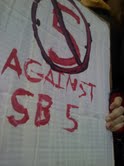
            On Tuesday I went to the rally in Columbus to stand in solidarity with the union workers who are facing the SB-5 bill that will eliminate most of their collective bargaining rights. These people are public servants, and yet the government that they work for is ready to strip teachers, firefighters and other public servants of their union rights. SB 5 stands to eliminate collective bargaining rights and gives the government the right to take the reigns without any checks and balances whenever they hit a "fiscal emergency"(which is most likely at government discretion). It also proposes merit pay, again at the government's discretion. At the rally I stood with about 50 Oberlin students, stood alongside firefighters holding signs that said “firefighters should be in charge of their own safety” and teachers with amusing signs that read something along the lines of “fyre the teechers, we don’t nead them!”  There were security guards who simultaneously kept us out of the state house and offered their sympathy for our cause. I was very caught up in the group dynamic. I waved a sign that said “against SB-5” with as much enthusiasm as I could while also chanting, texting updates and taking notes on my surroundings. Some signs were much more amusing than mine, my personal favorite being “off with his head”, directed at Governor John Kasich. There was a homemade “United we Bargain Divided we Beg” sign, a “wall street took the money don’t blame the workers” sign that I found poignant, lots of official red white and blue “stop war on workers” signs, an overwhelming number of “Kill the Bill”, and one family holding an “SB-5 hurts families”. However, the signs were not nearly as motivating as the chants. There was an ongoing “kill the bill” chant to go along with the sign, as well as “What’s Disgusting? Union Busting!”, “The People United Will Never Be Defeated” and my personal favorite, call and response Tell me what democracy looks like? This is what democracy looks like! Show me what democracy looks like? This is what democracy looks like!”


            Overall it was crowded and people were showing lots of enthusiasm but there was not a clearly identified plan or leader. The only time everyone was focused together, truly united chanting “Teddy” was when Ted Strickland took center stage, a.k.a. center steps.  He took hold of the megaphone and articulated what the union workers were looking for; respect. He shouted the message to the state: “Hell no, we wont go”, and ended his speech with a rousing “power to the people.”
 It was the biggest rally/protest at the Ohio state house since 1966, but this rally didn’t have a 60’s vibe.  This was evident in many ways: there was but one musician with a guitar in the entire crowd, no art, and no detectable recreational drug use. This is not a social revolution. At this point we are not even idealistic enough to try to move things forward, it is enough, for now, to keep them from moving in reverse.
I was happy to chant and wave a sign for this cause, even though my emotional connection to labor unions comes 2nd hand, through the classes I have taken and the books I have read. This bill will not directly effect my life the way that some of the other aspects of progress the conservatives are trying to reverse will.  At one point some Oberlin students entertained the idea of getting arrested for this cause but personally I am not close enough to the issue. It is appropriate and good for us to be there, bringing fresh energy and our opinions to the rally but I know that many students at Oberlin still don’t feel like Ohioans, myself included. I think it is important for us to show where our allegiances lie in a way that allows us to support and follow the lead of the people SB-5 is really effecting, and that is the public servants of Ohio, and the permanent residents.